










Amazon catalog management for cleaner product data and stronger account control

Sell Insights manages product data, variation structures, listing status, identifiers, categories, and catalog issues so your team can maintain a cleaner, more reliable Amazon account.
Start with clarity

Talk to an Amazon strategist

Services Page Form
$ 0 M+

Combined Client Revenue

0 +
Brands Scaled on Amazon
< 0 Day
Average Response Time
0 +
Years of Experience

What is Amazon Catalog Management?

Amazon catalog management keeps product information, variation structures, identifiers, categories, and listing status accurate, organized, and aligned across the account.

Product data control

Titles, attributes, identifiers, categories, and product details are reviewed for consistency and accuracy.

Variation structure

Parent-child relationships and variation themes are organized to support a clearer product experience.

Issue resolution

Suppressed, inactive, duplicate, and conflicting catalog records are documented and prioritized for action.

Six areas covered by Amazon catalog management

The scope is tailored to your catalog size, product structure, active issues, and the level of ongoing support your team needs.

01

Product Data Accuracy

We review titles, attributes, identifiers, categories, and core product information to reduce inconsistencies and improve catalog reliability.

02

Variation & Parent-Child Management

Variation themes, parent-child relationships, duplicate children, and grouping logic are reviewed for a clearer buying experience.

03

Suppressed & Inactive Listing Review

Listings with visibility, status, or data issues are organized by cause, business impact, evidence, and next action.

04

Category & Attribute Corrections

Incorrect categories, missing attributes, conflicting values, and product-type mismatches are identified and prioritized for correction.

05

Identifier & Duplicate Record Support

GTIN, UPC, SKU, duplicate product records, and conflicting catalog entries are reviewed to clarify the right resolution path.

06

Catalog Change Tracking & Governance

Approved updates, pending issues, evidence, owners, and outcomes are recorded so catalog changes remain visible and controlled.

How the catalog management process works

A repeatable workflow keeps catalog issues, evidence, approved changes, and outcomes connected from review through maintenance.

01

Audit the catalog

We review catalog structure, listing status, product data, variations, identifiers, and known issue history.

02

Prioritize the issues

Problems are ranked by visibility, conversion impact, operational risk, evidence, and dependency on other updates.

03

Implement approved changes

Validated corrections are prepared, documented, and carried through the agreed update process.

04

Monitor and maintain

Completed changes, unresolved issues, recurring errors, and new catalog needs are tracked for follow-through.
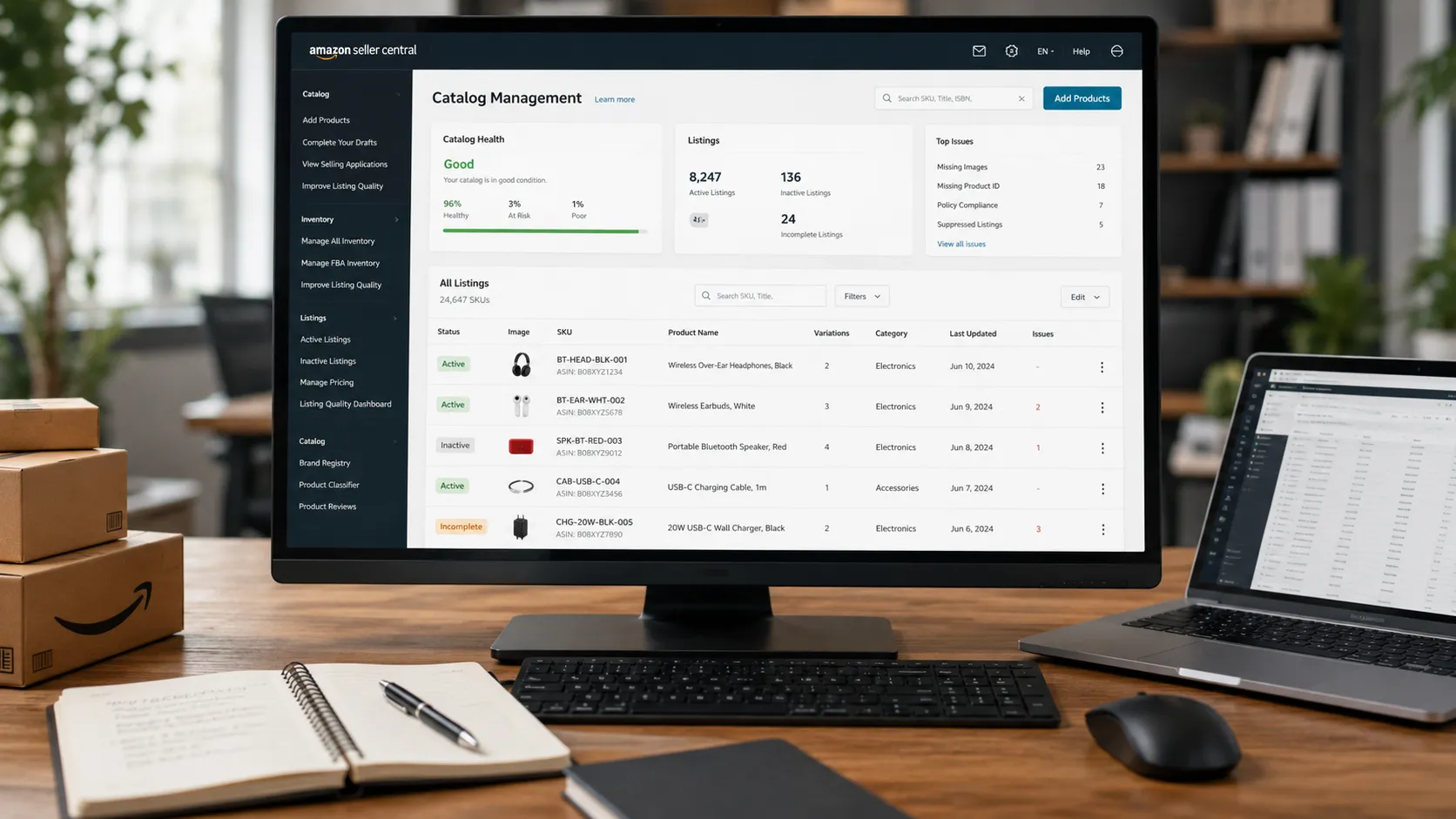
When catalog errors quietly block visibility and conversion

Incorrect attributes, broken variations, duplicate records, and inactive listings can limit discoverability and create a confusing product experience. Structured catalog management connects each issue to evidence, ownership, and a clear next action.

Structured catalog management vs ad hoc listing fixes

The difference is not simply making edits. Strong catalog management connects data accuracy, evidence, dependencies, change control, and ongoing follow-through.
Catalog Area Ad Hoc Fixes Sell Insights Management Practical Output
Catalog Direction Issues are handled only when they become urgent One catalog roadmap ranks work by impact, evidence, and dependency Clear priorities and ownership
Product Data Individual fields are changed without checking related values Attributes, identifiers, categories, and product information are reviewed together More reliable product records
Variations Parent-child issues are patched one listing at a time Variation structure is reviewed across the full product family Cleaner grouping and navigation
Listing Status Suppressed or inactive listings are addressed reactively Status issues are categorized, documented, and tracked to resolution Better issue visibility
Change Control Updates are made without a shared record Approved changes, evidence, owners, and outcomes remain documented Stronger accountability
Maintenance The catalog is reviewed only after another problem appears Recurring issues and new product updates follow an ongoing review rhythm A more stable catalog system

What catalog management gives your team

The result is a clearer product catalog, visible issue ownership, and a controlled record of what was changed, why it mattered, and what still needs attention.

A cleaner catalog structure

Product data, listing relationships, identifiers, and categories are organized into a more reliable account structure.

Clear catalog issue visibility

Your team can see which issues are open, what evidence is available, who owns the next action, and what is blocking progress.

More reliable catalog updates

Approved changes follow a documented process, reducing repeated errors, conflicting edits, and lost context.

Catalog management connected to account growth

Sell Insights connects catalog accuracy, listing visibility, conversion priorities, operations, and account management so product data supports the wider growth plan.

01

Evidence-led corrections

Updates are prepared from available records, product facts, and catalog context instead of guesswork.

02

Controlled change process

Each approved update has a reason, owner, status, and documented outcome.

03

Connected priorities

Catalog work is aligned with listing optimization, creative, PPC, inventory, and launch needs.

04

Consistent follow-through

Open issues, recurring errors, and completed changes remain visible across management cycles.

Clearer strategy and stronger execution for Amazon growth

Sell Insights connects account management, listing optimization, catalog control, creative, PPC, analytics, and operations so Amazon brands can scale with stronger clarity.

Scoreboard Mentality

Recovery activity is measured against cases reviewed, amounts identified, outcomes, and unresolved items.

Convergent Strategy

Dates, quantities, charges, transaction references, and responses are checked carefully.

Attention to detail

The review scope follows the account history, records, priorities, and internal capacity.

Excellence in execution

Documentation, tracking, communication, and reconciliation follow a consistent process.

Who needs Amazon Catalog Management?

This service is useful when product data, variation structures, listing status, or catalog updates have become difficult to manage consistently.

01

The catalog has grown messy

Product data, identifiers, categories, and listing records no longer follow a consistent structure.

02

Variations are inconsistent

Parent-child relationships, variation themes, or product groupings create confusion for buyers and the internal team.

03

Listing status issues keep returning

Suppressed, inactive, duplicate, or conflicting records are fixed temporarily but reappear.

04

Catalog changes lack ownership

Updates are requested by different people without one record of evidence, status, or final outcome.

What catalog management clients value

Clear issue tracking, careful data updates, stronger variation structure, and consistent follow-through are central to the service.

Turn catalog complexity into a controlled management process

Discuss your catalog size, active issues, variation structure, and update priorities with Sell Insights. We will help define the right management scope.

Frequently Asked Questions

Clear answers about catalog scope, variations, listing status, required information, and ongoing account support.
The agreed scope can include product data review, variation and parent-child management, suppressed or inactive listing review, category and attribute corrections, identifier and duplicate record support, catalog change tracking, and ongoing issue management. The exact scope depends on catalog size, current condition, and business priorities.
Sell Insights can review the likely cause, organize the available evidence, prepare the recommended correction path, and track the issue through the agreed process. Resolution depends on the underlying data, account records, product requirements, and any additional information requested during the review.
Yes. We can review variation themes, parent-child structure, duplicate children, grouping logic, and product-family consistency. Recommended changes are based on product facts, buyer experience, catalog rules, and the wider listing strategy.
The required information depends on the issue, but may include product lists, identifiers, current listing data, variation structure, product attributes, category information, change history, issue screenshots, and any existing case notes. Sell Insights confirms the required files during onboarding.
Catalog accuracy affects listing visibility, conversion, PPC efficiency, inventory continuity, launches, and reporting. Connecting catalog work to account management helps the team prioritize issues by commercial impact and coordinate updates with the wider growth plan.